What was your biggest professional highlight of the past 12 months?
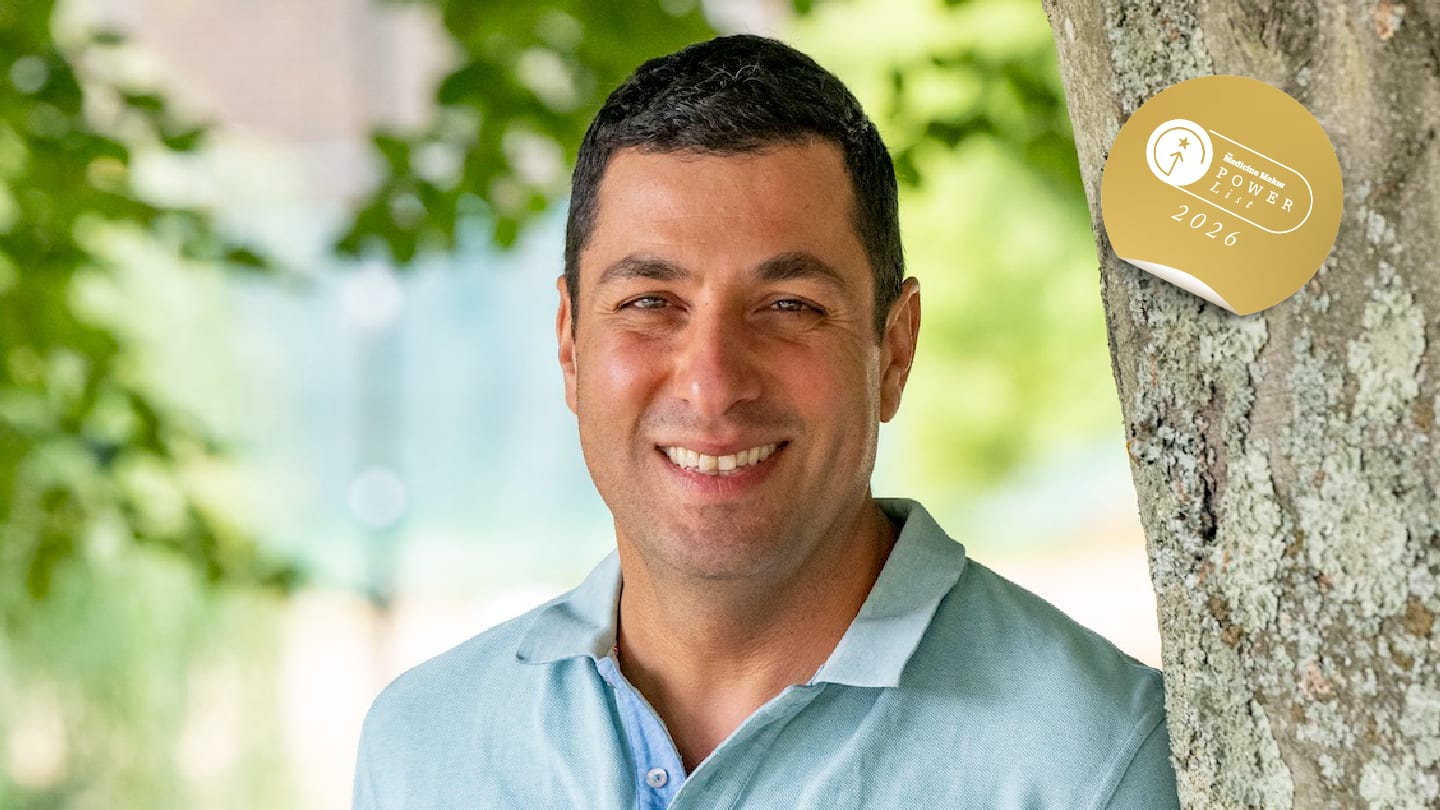
Being awarded the Royal Society of Chemistry's Interdisciplinary Prize, and being named on the Medicine Maker Power List 2025, was a real honor. It means a great deal for our work to be recognized by peers in both academia and the biotech industry. I have worked in the cyclic peptide space for 25+ years where, at times against the prevailing opinion, we stuck with our belief that intracellular screening of cyclic peptide libraries would change drug discovery. It is incredibly edifying to see Curve and other companies in the same space succeed, and to see the number of cyclic peptide drugs coming into the clinic and onto the market.
Where is the biopharma industry making real progress that isn’t getting enough attention?
The expansion of what we consider druggable. For decades the industry accepted that around 80 percent of disease-relevant proteins such as transcription factors, scaffolding proteins, the vast landscape of intracellular protein-protein interactions, were simply out of reach. That assumption is quietly collapsing. Cyclic peptides, molecular glues, targeted protein degraders, and covalent approaches to previously inert residues are all chipping away at it in parallel. The fundamental shift is that the addressable proteome is growing faster than at any point in my career. Targets we wrote off twenty years ago are now legitimate starting points for drug discovery programs, and that has profound implications for the diseases we can credibly take on.
What is the biggest bottleneck slowing progress in drug development – and how do we fix it?
The mismatch between scientific timelines and funding cycles. Drug discovery operates on a decade-plus timescale; venture capital typically operates on a three-to-five-year horizon to the next financing event. That tension shapes everything from which programs get started, which get killed, how much risk a company can credibly carry, and how honest leadership can be about timelines. A number of the companies bringing genuinely game-changing medicines to market this year have been going for ten years or more, and that is the reality of what it takes. Genuinely transformative science rarely fits neatly into the milestones the next round demands, and good programmes get reshaped or abandoned not because the biology failed but because the cycle did.
The fix is a more diverse capital stack for biotech. Traditional VC will and should remain central, but we need more patient capital alongside it; sovereign wealth, strategic pharma investment, evergreen funds, and government-backed translational funding that can carry programs through the valleys of death between scientific milestones and commercial inflection points. The UK and Europe in particular have made progress here but still lag the US in depth of capital and appetite for long-duration risk. Closing that gap is at least as important as any scientific advance, because without it, the science never gets the runway it needs.
What’s one widely held belief in your field that you disagree with – and why?
That peptides cannot be oral drugs. For most of my career the conventional wisdom has been that peptides are too large, too polar, too easily chewed up in the gut to ever work as oral therapeutics. That belief shaped which targets the industry was willing to pursue with peptides and which it wasn't, and it kept a huge swathe of biology off the table.
The work of the last fifteen years has steadily dismantled that assumption. Macrocyclisation, N-methylation, intramolecular hydrogen bonding, chameleonic behaviour that lets a molecule shift its properties between aqueous and membrane environments. These are not theoretical curiosities anymore, they have become design principles that practising medicinal chemists use to build orally bioavailable cyclic peptides. Several cyclic peptides coming to market have proved this point and there is a pipeline coming behind that proves the broader scientific one. I think we will look back on "peptides cannot be oral" as a generational assumption that turned out to be a failure of imagination rather than a law of nature.
How can the pharmaceutical industry become more resilient in an increasingly uncertain world?
By diversifying: across modalities, across geographies, and across the relationships that move science from discovery to patients. Companies that bet everything on a single target, a single therapeutic class, a single regulatory jurisdiction, or a single commercial market are fragile by design. Resilience comes from having small molecules, biologics, and emerging modalities like cyclic peptides and targeted degraders all in serious play, and from not being captive to the pricing and policy environment of any one country.
The other piece, and the one I think the industry talks about less honestly, is the partnership between biotech and pharma. Biotech takes the early scientific risk; pharma takes the late development and commercial risk. When that handoff works well, both sides win and patients get medicines. When it breaks, because of misaligned incentives, valuation gaps, or a pharma partner pulling back from external innovation; good science dies on the vine. A more resilient industry is one where that interface is treated as critical infrastructure, not as a transactional afterthought. That means longer-term partnerships, more risk-sharing structures, and pharma being willing to invest in biotech ecosystems rather than just acquiring at the point of derisking.
If you could introduce one policy change to accelerate progress in drug development, what would it be – and why?
Stronger pull incentives for areas of clear market failure. There are whole categories of medicine where the science is tractable, the patient need is undisputed, and the commercial model simply does not work; antimicrobial resistance most obviously, but also rare paediatric diseases, neglected tropical diseases, and pandemic preparedness. In each case, the conventional volume-based pricing model that funds most of pharma fails to align with what society actually needs. A novel antibiotic that works is, paradoxically, one we want to use as little as possible. A medicine for a rare paediatric disease serves a population too small to support the cost of development under normal economics. The result is that companies have systematically exited these spaces, and the pipelines are dangerously thin at exactly the moment we need them to be deep.
The fix is pull mechanisms that guarantee revenue, subscription-style payments, market-entry rewards, and priority review vouchers. We need systems that decouple the financial return from the volume sold. The UK's NHS antimicrobial subscription pilot was an important proof of concept, and similar models are being developed elsewhere. What is needed now is for this kind of structure to become the global default in areas of market failure rather than a handful of national experiments. Policy can fix markets where markets cannot fix themselves, and that is where governments have the most leverage to accelerate progress in the medicines we most urgently need.
What will look completely different about drug development in 10 years?
The timeline from idea to clinical candidate. The five-to-seven years it currently takes to go from a validated target to a molecule ready for the clinic is going to compress dramatically; not because of any single breakthrough technology, but because the whole stack is improving in parallel. Human genetics and functional genomics are sharpening target validation before a single molecule gets made. Generative models are reshaping how we design molecules and explore chemical space. Automated synthesis and high-throughput biology are collapsing cycle times in the lab. Human-relevant screening platforms such as organoids, patient-derived systems, in vitro disease models are letting us ask better questions earlier. Together these approaches will change what is possible.
What I do not think will happen is AI replacing chemists or biologists. The discipline-specific judgement that takes a decade to develop is not going away, and the projects that succeed will still be the ones run by people who deeply understand the biology and the chemistry. What will change is that those people will be doing in two or three years what previously took six or seven. The bottleneck will move, probably to clinical development, where human biology sets a pace that no algorithm can shortcut. That is where the next generation of innovation will need to focus.
Do you think your younger self would be surprised to see the career you’ve had?
Honestly, not as surprised as people might expect. From quite early on I had a clear sense of the kind of science I wanted to do and the questions I wanted to answer. I was interested in working at the interface between chemistry and biology long before it became the norm, and similarly our work on intracellular cyclic peptides and undruggable targets significantly predates the current general enthusiasm. What I could not have predicted was the shape the career would take around that science. The younger version of me would be genuinely surprised to find himself becoming a Professor, founding and running a biotech company, raising venture capital, and doing an MBA. The container has changed more than I would have guessed; the scientific approach of tackling challenging problems at the centre of it has stayed remarkably consistent.
What I am most grateful for is the people. The mentors, students, postdocs, collaborators, colleagues, and funders I have worked with over twenty-five years are the reason for my success, and the privilege of building Curve alongside people I trust and admire is something my younger self would not have known to hope for. In the end, science is a team sport, and the most difficult questions can only be tackled by high-performing teams pulling in the same direction.
Newsletters
Receive the latest pharmaceutical news, personalities, education, and career development – weekly to your inbox.