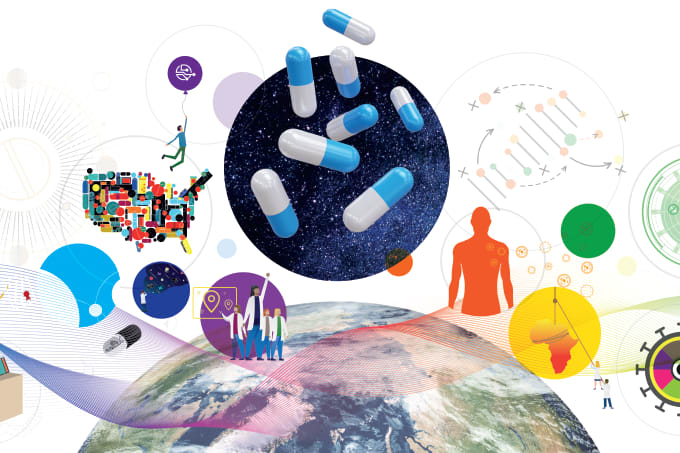
In September, during the World Medical Innovation Forum 2025, academic leaders at Mass General Brigham identified the top 12 “Big Ideas in Medicine”. In November, we published the insights of numerous industry professionals as they shared their own ideas of what the “Big Ideas in Medicine Manufacturing” might be. Part II brings more insights inspired by the same single question: What’s getting stakeholders excited about the future of pharma manufacturing?
Drew Hope, Senior GMP Compliance Consultant and Qualified Person, eXmoor Pharma
“As a QP in the CGT sector, I am frequently struck by how automated production systems present difficulties with regards to compliance. Too often, automated systems are established with gas or air filtration systems – the integrity of which cannot be tested to the standards required. Placing production systems into a machine simultaneously applies cleanroom standards in the machine. They must be easy to clean and decontaminate. Air quality standards within automated systems must be appropriate, with built in methods to confirm total and viable particle limits are met. These compliance issues are frequently overlooked by automation developers that are then unwilling or unable to adapt to their customers’ needs. When automation is developed neglecting the principles and guidelines of GMP, manufacturers, not the system developers, will face regulatory challenges.
“Compliance for AI is a very new and evolving topic. It may be used in GMP sites to aid trending of data, which may predict nonconformities before they occur. It also may be a central component of the manufacturing activity. The recent proposed EMA Annex 22 draft contrasts with the paucity of existing clear regulatory guidance for AI. Manufacturers must climb a steep learning curve to ensure that the AI systems they onboard from suppliers are compliant and become that human-in-the loop to ensure the risk-based control, data integrity and documentation are sufficient. At the same time, suppliers must adapt quickly to the rapidly evolving regulatory landscape to ensure that algorithms, model training, validation and testing are compliant.”
Stella K. Vnook, CEO, Likarda
“The next big idea in medicine manufacturing isn’t a single technology — it’s the intelligent integration of biology, automation, and data. In cell and regenerative therapy manufacturing, we’re now using AI not just for predictive modeling but for real-time decision making.
“Automation is redefining scalability: modular microfactories and closed-loop encapsulation systems allow complex biologics and living therapies to be produced closer to the point of care. What was once a centralized, fragile supply chain is evolving into a distributed, data-driven manufacturing ecosystem.
“Sustainability follows naturally – by reducing cold-chain dependency, optimizing media utilization, and enabling reusability of bioreactors, AI-driven automation is cutting waste and cost while increasing accessibility. The future of medicine manufacturing lies in adaptive systems – intelligent, self-correcting platforms that make cell therapy as scalable and reliable as conventional pharmaceuticals.”
Joel Eichmann, Co-Founder and Managing Director, Green Elephant Biotech
“Sustainability is becoming a design principle in bioprocessing, not a compromise. In cell culture manufacturing, plant-based materials such as polylactic acid (PLA) now enable single-use bioreactors and labware with up to 90 percent lower carbon footprint than conventional polystyrene. Combined with additive manufacturing, these systems can be produced with far less raw material while maintaining full regulatory compliance. Beyond lowering emissions, 3D printing accelerates design iteration and supports modular, scalable setups for adherent cell culture. The result is a new generation of sustainable bioreactors that use fewer resources, perform more efficiently, and demonstrate that environmental responsibility and technical excellence can advance together.”
Gabriella Gentile, Chief Operating Officer, Symeres
“As the landscape of pharmaceutical manufacturing continues to evolve, the need for agility, efficiency, and smarter collaboration is more relevant than ever. With more emphasis placed on the relationship between biotech, pharma, and outsourcing partners, one thing is clear: the future of innovation will hinge on effective partnerships.
“Biotech companies are the engine of discovery, often pioneering breakthrough molecules but lacking the infrastructure or expertise to advance these compounds into clinical and commercial stages. This is where discovery and development outsourcing partners can step in to bridge the gap from early discovery through development. By enabling biotechs to progress candidates efficiently, and de-risk programs before pharma acquisition or licensing, effective outsourcing partnerships can accelerate the entire innovation lifecycle.
“The traditional handover model between biotech, pharma, and outsourcing partners is giving way to more dynamic, integrated collaborations that can help de-risk molecule development. In these situations, the outsourcing company goes beyond just providing a service to become a true strategic partner. However, these partnerships must stay grounded in agility and efficiency. Time remains the single greatest constraint in bringing therapies to patients, and the partnerships that thrive will be those capable of lean, responsive operations. Seamlessly adapting to project needs and regulatory demands is becoming essential in today’s macroeconomic and geopolitical climate, where both pharma and biotech face increasing pressures on R&D investment.
“For both biotech and pharma companies, the opportunity lies in embracing end-to-end collaboration models that span from candidate discovery through to manufacturing. Integrating early-stage discovery expertise with development and manufacturing capabilities can enable a smoother transition from research to clinic, reducing both technical and financial risk. These partnerships can empower organizations to move faster and more efficiently, maximizing the potential of promising molecules while maintaining flexibility in an increasingly complex and cost-sensitive environment.”
In an era where innovation is as much about partnership as it is about science, the most successful players in pharmaceutical manufacturing will be those who think collaboratively to redefine not only how drugs are made, but how innovation itself is achieved.
Matthieu de Kalbermatten, CEO, CellProthera
“Beyond decision algorithms, regulatory loops, and layers of data analysis, automation and AI support sustainability: pharmaceutical manufacturing is entering an era of continuous learning. We will no longer have a process that runs, we will have a process that learns, transforming the world of pharmaceutical production. Artificial intelligence, combined with advanced automation, is turning the entire manufacturing chain upside down, from raw material processing to primary drug packaging.
“The great revolution is not so much automation, which has existed for many years, but its alliance with AI. This synergy transforms operations that were once manual, complex, and a source of variability into self-optimizing, predictive processes.”
Jean-Olivier Hirsch, COO, CellProthera
“The future of pharmaceutical plants will be marked by an increase in the use of AI, making them not only faster and more profitable, but also more resilient. The boundary between data science and biotechnology is disappearing – engineers, data scientists, and biologists now work hand in hand.
“In ten years, most critical production decisions will be AI-assisted. AI will not replace human decision-making on tasks where intelligence is required, but it will facilitate and accelerate the decision-making process through access to knowledge – and when that day comes, we'll no longer be talking about automation, but about industrial co-intelligence.
“We are in a new era of learning bioproduction. This near future promises to profoundly transform the way we manufacture the therapies of the future.”
Jonathan Wofford, CCO, Title21
“Adaptive manufacturing, powered by AI and predictive analytics, is redefining how therapies are developed, scaled, and delivered. For the life sciences, variability is inevitable, but intelligent systems can anticipate process deviations before they occur, enabling proactive control rather than reactive correction. By unifying quality, manufacturing, and patient data in real time, manufacturers gain the visibility to optimize production without compromising compliance or safety. This shift allows organizations to learn continuously from every batch and patient outcome, transforming the entire manufacturing process into a living, self-improving ecosystem. This data-driven approach is key to advancing patient safety, improving therapeutic consistency, and creating a more innovative, more resilient manufacturing model for the future of medicine.”
Angelo Raggioli, Head of Technology Development, ReiThera
“AI and automation are fundamentally reshaping scalability and output in viral vector manufacturing – and the broader cell and gene therapy sector. By integrating high-dimensional experimental data with automated analytics, we can now extract actionable insights that were previously hidden in fragmented datasets. This data-driven approach transforms development from empirical iteration to informed decision-making, drastically accelerating the path from optimization to industrial scalability.
“More broadly, AI-based pattern recognition, predictive analytics, and digital-twin modelling are redefining how we design, execute, and scale manufacturing processes. These tools not only increase yield and product consistency, but they democratize access to high-quality manufacturing knowledge, turning data into a shared, learning system that drives continuous improvement.”
Liza Loidolt, General Manager Cell & Gene Therapies, Terumo BCT
“The conversation sparked by the World Medical Innovation Forum’s “Big Ideas in Medicine” is a timely reminder that breakthrough science must be matched by equally bold advances in how we manufacture medicines. Across the pharmaceutical supply chain, several “Big Ideas in Medicine Manufacturing” are beginning to stand out – not only for their disruptive potential, but for their ability to reshape scalability, reliability, and sustainability in the years ahead.
“One of the most transformative themes is the integration of AI-native manufacturing. We’re seeing accelerated adoption of AI models that predict batch deviations, optimize bioprocess parameters in real time, and enable adaptive control strategies. Unlike previous automation, these systems learn continuously, allowing facilities to move beyond rigid, recipe-driven workflows toward dynamic, self-optimizing production. This is especially powerful in complex biologics and gene therapies, where manufacturing consistency has historically been a barrier to scale.
“A key area of innovation is real-time analytics and adaptive process controls to better predict, control, and adapt manufacturing outputs. These approaches help therapy developers optimize outcomes, reduce costs, and accelerate delivery of treatments. Early adopters have reported measurable improvements in operational efficiency and speed to market.
“Advanced automation and analytics are also enabling more precise control over critical parameters, reducing manual interventions, and improving consistency across cell collection, processing, and expansion workflows. Predictive algorithms and process optimization can help ensure that each step – from raw material input to final product – meets rigorous standards for yield, viability, and regulatory compliance.
“These advances in manufacturing are not just technical achievements – they are catalysts for hope. By enabling therapy developers to deliver life-changing treatments more reliably and efficiently, these innovations are helping turn big ideas into real solutions for patients who need them most.”
Christie Malone, Vice President Biotherapies Custom Solutions, Vitalant
“AI now plays a central role in real-time process optimization. Continuous data streams from sensors, imaging systems, and analytical tools allow AI models to track critical quality attributes and adjust culture conditions real-time. This capability improves cell yields, shortens production timelines, and reduces cost per dose. AI-enabled quality control also accelerates decision-making by replacing slower, manual image review with rapid, high-precision analysis capable of detecting subtle changes in viability and differentiation.
“Automation strengthens this intelligence layer by reducing human intervention and supporting a more controlled manufacturing environment. Closed-system bioreactors, automated media exchanges, and robotic handling help minimize contamination risks and improve batch-to-batch consistency. These platforms also enable easier technology transfer and greater reproducibility across sites, which is essential for commercial scale.
“Together, AI and automation are redefining what is possible in cell therapy manufacturing and are establishing the foundation for reliable, scalable, and globally deployable production.”
Priya Baraniak, Chief Commercial and Development Officer, Pluristyx
“Sustainability has emerged as a major driver of innovation in medicine manufacturing, especially as advanced therapies move toward wider adoption. The shift from open, manual processes to closed and automated systems is producing measurable environmental benefits while simultaneously reducing operational costs.
“One of the most significant improvements comes from changes in cleanroom requirements. Closed-system manufacturing can operate in less stringent environments, which reduces energy use for temperature control and air handling. Some assessments show that this transition can cut greenhouse gas emissions by more than 50 percent per manufacturing cycle. Shorter production timelines and fewer manual interventions also reduce the number of days a cleanroom must run at full intensity.
“Resource utilization is improving as well. Smaller, more efficient platforms, including microfluidic systems and compact bioreactors, reduce reagent consumption and generate less waste. Many organizations are also expanding recycling programs and exploring biodegradable alternatives to conventional single-use plastics, further lowering environmental impact.
“These developments highlight a clear trend: sustainable manufacturing practices are not separate from operational excellence. They are integral to building a more efficient, resilient, and responsible future for advanced therapy production.”
Newsletters
Receive the latest pharmaceutical news, personalities, education, and career development – weekly to your inbox.