
The Medicine Maker
  • Explore

    Explore

    • Latest
    • Features
    • Interviews
    • Business & Trends
    • Technology & Manufacturing
    • Product Profiles
    • White Papers

    Featured Topics

    • Biopharma
    • Small Molecules
    • Cell & Gene
    • Future of Pharma

    Issues

    • Latest Issue
    • Archive
    • Cell and Gene Therapy Supplement
  • Topics

    Topics

    • Cell & Gene
    • Bioprocessing
    • Drug Delivery
    • Drug Discovery
    • Development & Clinical
    • Formulation
    • Facilities & Equipment
    • Outsourcing
    • Packaging
    • Regulation & Standards
    • Small Molecules
    • Supply Chain
  • News & Blogs

    News & Blogs

    • Industry News
    • Research News
    • Blogs
  • Events
    • Live Events
    • Webinars
  • Community & Awards

    Community & Awards

    • Power List
    • Sitting Down With
    • Innovation Awards
    • Company of the Year Awards
    • Authors & Contributors
  • Multimedia
    • Video
    • eBooks
    • Content Hubs
Subscribe
Subscribe
The Medicine Maker / Issues / 2016 / Aug / Viral Invaders
Manufacture Business & Trends Bioprocessing Biopharma Sponsored

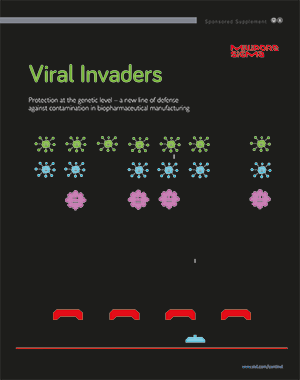
Viral Invaders

Protection at the genetic level – a new line of defense against contamination in biopharmaceutical manufacturing

08/23/2016 1 min read

Sponsored By

Share

Download the pdf here

Chinese hamster ovary (CHO) cells have been a staple of biopharmaceutical manufacturing since the 1980s. It’s been three decades since scientists first started experimenting with CHO cell culture for protein production and, in that time, the industry has garnered a vast amount of knowledge and experience with CHO cells – but challenges remain. Working with living organisms is difficult; cells do not always behave as intended, nor as you would like them to – and, to make matters worse, adventitious viruses are a continual threat against the process. Though viral safety in biomanufacturing is better than ever before, the industry must not grow complacent. A contamination event can shut down a plant for weeks or months while the problem is resolved – generating huge costs and potentially even causing shortages of life-saving medications. Technologies in this area are constantly advancing to help reduce viral contamination, but no company is immune to the risks, as highlighted by highprofile contamination incidents at large, global companies. Millennia of evolution have made viruses the ultimate survival machines, and no single strategy can guarantee total elimination of viral risk. One of the major threats for manufacturers using CHO cells is minute virus of mice (MVM) contamination, which can be shed anywhere mice are found, including warehouses, factories, farms and shipping containers. Because it is so small, MVM removal is difficult and just one virus particle per liter can infect a whole bioreactor – costing millions of dollars. The contamination often goes undetected until a lack of productivity in CHO cell cultures is noticed in the bioreactor. Regulators now expect manufacturers to test every bulk harvest for MVM, and there is a firm expectation that no detectable virus will be found.

It is crucial to keep building viral defenses, and developing new ways to detect, destroy and evade MVM. To that end, the Medicine Maker is delighted to co-present this compendium on viral risk mitigation with MilliporeSigma and allow them to introduce CentinelTM, a means of generating MVM-resistant CHO cells. Centinel was developed using MilliporeSigma’s zinc finger nuclease gene-editing technology, and represents another layer of defense for manufacturers. In the following pages, experts in virology and gene editing discuss how the problem of contamination has changed over the years, describe how gene-editing technology was used to engineer a safer form of CHO cell, and consider the future potential of productivity-enhancing alterations.
Download the pdf here

Newsletters

Receive the latest pharmaceutical news, personalities, education, and career development – weekly to your inbox.
Newsletter Signup Image

Recommended

Related Content

Breaking Manufacturing Bottlenecks in Nucleic Acid Therapeutics
Biopharma Biopharma
Breaking Manufacturing Bottlenecks in Nucleic Acid Therapeutics

August 31, 2026

4 min read

New approaches to oligonucleotide production, mRNA design, and supply chain control could help turn promising nucleic acid therapies into scalable commercial products

The Hidden Complexity of Stability Storage
Biopharma Technology & Manufacturing
The Hidden Complexity of Stability Storage

August 27, 2026

9 min read

Why preserving samples is a scientific, regulatory, and operational challenge – and what’s at risk when it goes wrong

Green Shoots, Gray Skies
Biopharma Interviews Business & Trends
Green Shoots, Gray Skies

August 26, 2026

9 min read

Jon Rees sees signs of recovery following biotech's post-pandemic funding reset, but there’s no going back to the “old normal”

Phase III Success Marks Milestone for Personalized Cancer Vaccines
Biopharma Industry News Development & Clinical
Phase III Success Marks Milestone for Personalized Cancer Vaccines

August 26, 2026

7 min read

Merck and Moderna report positive phase III results for intismeran in melanoma, as The Medicine Maker revisits how cancer vaccines work and the challenges still facing the field

The Medicine Maker
Subscribe

About

  • About Us
  • Work at Conexiant Europe
  • Terms and Conditions
  • Privacy Policy
  • Advertise With Us
  • Contact Us

Copyright © 2026 Texere Publishing Limited (trading as Conexiant), with registered number 08113419 whose registered office is at Booths No. 1, Booths Park, Chelford Road, Knutsford, England, WA16 8GS.

Affiliations:

Specialties:

Areas of Expertise:

Contributions: